Among the many places where PIME (Pontifical Institute far Foreign Missions)
worked in Asia, the mission in India is the one that best of all represents the
continuity of its work. Far 150 years, about 150 missionaries have worked far
the plantation of the Church in the Telugu region and now Telugu missionaries
are going abroad to witness the Gospel of Jesus in other countries.
PIME is an institute of diocesan priests. Their purpose is to plant the Church
and develop the dioceses. So when a diocese is ready they leave everything and
start somewhere else. The Church in Andhra is having at present twelve diocese:
Six have come out of the territories entrusted to PIME: Hyderabad, Vijayawada,
Warangal, Eluru, Nalgonda and Khammam.
The readers will be able to discover the burning faith that was behind those men
who left their country and came to die in a far away land. They were not without
defects.
We can learn from their mistakes and change our methods.
But their faith should remain our guiding light.
Fr. Carlo Torriani
Born in Italy, 1935
Ordained Priest, 1960
First Secretary of MANI TESE, Freedom from Hunger Campaign Movement of Italy
Came to India, 1969
Master of Theology, JDV, Pune, 1970
Master of Social Work, TISS, Mumbai, 1972
Founder of Lok Seva Sangarn, 1976
Indian Citizen, 1981
Founder of Swarga Dwar, 1983 http://www.swargadwar.com/aboutme.htm
|
PRESENTATION |
PREFACE |
INTRODUCTION |
BIBLIOGRAPHY |
|
PART ONE
THE MISSION OF HYDERABAD |
PART TWO
PARTITION OF HYDERABAD MISSION |
PART THREE
REGIONAL SUPERIORS |
PART FOUR
DEVELOPMENT OF PIME IN ITALY |
Two PIME
missionaries at Hyderabad:
5th June 1855
Christianity in India
The cradle of Christianity
Padroado and Propaganda
Carnatic Mission
The first Telugu Christians
The decline
The missionary renaissance
The first Bishop in Hyderabad:
Daniel Murphy (1845-1869)
"The hospitality was very cordial"
"Your missionaries are a blessing"
Which language to study?
Two parts: Nizam and British Territories
European Brahmin
New Missionaries: Bigi and Caprotti
The Bishop is worried
The tidal wave
Why Murphy left?
Domenico Barbero:
first PIME bishop (1870-1881)
Pastoral visit
Bishop Pietro Caprotti goes out to the Telugu (1882-1897)
Turlapadu: providential events
The Koyas: the wrong time
Gospel on the railways
Expansion work
Vijayawada comes up
Efforts to get local clergy
Apostolic Delegation
A stern saint: Fr. Giambattista Ciccolungo
Raichur and Bhir: a West too far
Marathi District
Kannada District
Fr. OpiIio Negri, an intrepid missionary
Pietro Viganò: a holy and learned bishop (1897-1908)
Missionaries die young:
Fr. Luigi Cantaluppi
Diaries of Viganò: a mine of information
The ever present caste problem
A balance sheet
The long period of Bishop Dionigi Vismara (1909-1948)
The great conversion movement
Dalit Movement part of National Movement
The "Common Letter"
Fr. Silvio Pasquali: The Friend of the Dalits
Fr. Ugo Pezzoni: The Apostle of Krishna District
Fr. Pio Tentorio: cholera or poison?
Fr. Paolo Fontana: cholera: the big killer
The person of Vismara |
A new diocese:
Vijayawada. Bishop Domenico Grassi (1939-1951)
The spadework of the Catechists
Lazarus Sanyasi
Arava Davidu
Br. Joseph Thamby
Pastoral and Sodal Work
Lay Missionaries
Gunadala: An industrial school
A shrine for pilgrimage
A generous Jesuit: Fr. Pietro Caironi
Fr. Carlo Merlo: Dharmaraja
Fr. Deodato Desenzani:
Health care for the rural India
Fr. Vincenzo Pagano and the Godavari Delta
The PIME Sisters
Bishop Ambrogio De Battista(1951-1971)
A good organiser and administrator
An example for other dioceses
A vicar for all seasons: Angelo Bianchi
Fr. Giovanni Leoncini
Mario Fumagalli: the Father of handicapped children
The second partition of Hyderabad: Warangal Diocese
Bishop Alfonso Beretta (1951-1985)
Bro. Pasquale Sala: the builder of Fatimanagar
First priority: the local clergy
Beretta: a man of great culture
The Golden Missionary Age
Fr. Augusto Colombo: the volcanic man
Medical Work
Main purpose: promotion of the Harijans
Nalgonda diocese: a fruit of PIME's work
The other evangelizers of Andhra
The return to Hyderabad
|
Fr. Umberto Colli.(1929-36)
A Father to all
Fr. Cesare Mariani (1936-47)
A referral point in the war
Fr. Paolo Arlati (1953-65) A Guardian Angel for all
Fr. Carlo Radice (1965-69) It is necessary to come out of Andhra
Fr. Bruno Venturin (1969-73) A Superior out of place
A new opening in Mumbai
Fr. Angelo Biffi (I973-79) The man able to stand
Fr. Domenico Vivenzi (I 979-86) A push for internationalization
The long march of Internationalization
It started in America and Brazil
Leoncini starts in India
The recruitment in India was stopped
The Chapter of aggiornamento
The change at Tagaytay
Why so much delay?
Two seminaries: Eluru and Pune
Promising results
Fr. Benito Picascia (1986-94) The Founder of PIME in India
Fr. Augustine Palett (1994-2002) The first Indian Superior
Fr. Melchior Durgam Raja (2002 ) Deepening the roots in India
|
PIME:
the first Italian missionary institute
Lombard Seminary for Foreign Missions
Missionaries who know how to govern themselves
Missionaries of San Calocero
Giacomo Scurati:
a good animator (1891-1901)
The Golden Jubilee
Filippo Roncari:
a Director form the diocese (1904-1908)
A moment of crisis
Pietro Viganò:
a Director from India (1909-1913)
Giuseppe Armanasco:
the first elected Director (1913-1924)
The rise of Fr. Paolo Manna
Paolo Manna:
the first Superior General (1924-1934)
Consolidation of the Institute in Italy
PIME: two roots, one Institute
The first visit to all the missions
The fruits of Manna's "Observations"
A prophetic vision
Regional Superiors in the missions
The PIME Sisters
The Clergy Missionary Union
The harsh years of Lorenzo Balconi, Superior General (1934-1947)
Diocesan versus Religious
Luigi Risso:
a gentle General Superior (1947-1957)
Augusto Lombardi:
the Superior who believed in India (1957-1964)
Vocations from India
Aristide Pirovano: a good manager as Superior (1965-1977)
Changing scenario in the missions
The preference for Asia
The search for new ways
"Inforpime": a tool for internal exchange
Two superiors from the far East
"Opening up to the value of internationality"
Two international seminaries
International at all levels
|
PRESENTATION
With profound sense of gratitude for all the blessings and the graces the
church in Andhra Pradesh has received, I join the PIME missionaries in their
celebration of the 150th year of the arrival of Fathers Dominic Barbero and
Francesco Pozzi, the first batch of PIME missionaries to come to India and then
to Andhra Pradesh in 1855. It is to be placed on record that PIME's presence in
AP has been quite uninterrupted.
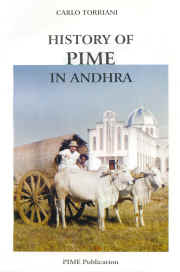
The History of PIME in Andhra Pradesh, written by Fr. Carlo Torriani, a PIME
priest, pays tributes of praise to the "true heroes of the Church" who
preached the gospel and built up Catholic communities in Andhra Pradesh. I do
join him paying tribute of my own appreciation and admiration to all the PIME
missionaries who worked and who are doing their apostolic ministry in Andhra
Pradesh. Their tireless labours have resulted in the creation of one Archdiocese
and seven dioceses. They also formed one Archbishop and three bishops from the
local people whom they baptized. Indeed PIME's apostolic efforts have realized
to a great extent the prophetic words of Pope Leo XIII. "Thy sons, Oh,
India will be your own ministers" ,
I am privileged to have been baptized and formed by PIME missionaries. I have
again the rare privilege of succeeding two PIME bishops in the diocese of
Vijayawada and two PIME vicars apostolic and four PIME bishops in Hyderabad.
Every mission history, like the Acts of the Apostles, teaches that it is the
Holy Spirit who opens the hearts of the listeners to respond to proclamation of
the Good News. Missionaries are the instruments in the hands of the Holy Spirit.
They succeed to the extent they follow the promptings of the spirit. Fr
Torriani's book is an illustration of the success of missionaries who lived a
life of prayer, spirit of sacrifice and simple lifestyle.
I congratulate Fr Torriani for bringing out this History of PIME in Andhra
Pradesh. I recommend it to all the missionaries and those who desire to be
missionaries.
Once again I express my deep sense of gratitude to all the PIME missionaries who
have worked and are working in Andhra Pradesh. I pray for the eternal rest of
all the departed PIME missionaries who worked in Andhra Pradesh the land of
their adoption.
+ M. Joji
Archbishop of Hyderabad
January 17, 2005
PREFACE
The purpose that I put to myself in writing this short history of the work of
PIME missionaries in India, is to offer to the young Indian PIME members and
seminarians a narration of how everything started, who had been the holy and
courageous men and women who witnessed the love of Christ in this part of our
country, so that they may be moved to continue this witnessing also in other
parts of the world.
To have a full history of PIME in India on the line of the work done by Fr.
Giovanni Leoncini for the diocese of Vijayawada, much more time and research is
needed. He started collecting material while he was editor of In Vinculo
Christi for more than thirty years. I never had a chance like this. If an
Italian edition of this book is required, without the compulsory short term date
of the 150 Years Celebration, then a deeper study can be done and a more
voluminous book can be produced.
It is my sincere and deep desire that the young Indian members, and the readers
in general, will be able to discover the burning faith that was behind these men
who left their country and came to die in a far a way land. They were not
without defects, may be they made mistakes. Faith does not cancel our defects
and does not prevent us from making mistakes. Their methods and language may be
outdated. We can learn from their mistakes and change our methods. But their
faith should remain our guiding light.
Things have change a lot in 150 years, but still the invitation of Jesus:
"Go! You will be my witnesses till the end of the world" is the only
moving force behind the missionary movement.
Jesus told also his disciples: "do not take money with you". For at
least half of the 150 years under consideration, this was the stark reality for
the missionaries: they were leaving Italy in poverty and they were living in
India in poverty. Things now may be changed. Foreign missionaries, in the latest
decades, can dispose of lot of money coming from Christian western countries.
Priests and missionaries can be lured by this gilt.
Money, said Jesus, is something "tainted", that is ambivalent. It can
be a sign of the sharing requested by the Christian faith, or it can be the
instrument for buying every thing you want, including souls. The missionaries
Church is economically depending from the West. Christian families want to have
some of their children in the religious life because, they know, they will be
better off. We can't deny that these chances are there, that temptations are
real, that in this situation it is more difficult to show the purity of
Christian witnessing.
Indians have always had great esteem for the sanyasi (those who renounce world
and wealth). Are Christian Indian missionaries seen as sanyasi? Buddhism had
gone all over the East on the steps of itinerant monks. Christianity, often
spread all over the world on the ships of colonialists. When shall we see a new
kind of Indian non-violent Christian missionary sanyasi? That will be possible
only going back to that simple faith that brought Fr. Barbero and Fr. Pozzi from
Milan to Hyderabad on that May 1855.
This is our wish and our prayer.
Fr. Carlo Torriani, PIME
Swarga Dwar, February 5, 2005
INTRODUCTION
Among the many places where PIME (Pontifical Institute for Foreign Missions)
worked in Asia, the mission in India is the one that best of all represents the
continuity of its work. For 150 years, about 150 missionaries have worked for
the plantation of the Church in the Telugu region and now Telugu missionaries
are going abroad to witness the Gospel of Jesus in other countries. For a
hundred years, PIME sent its personnel only to Asia: in Melanesia, Borneo,
China, Hong Kong, Myanmar and India. But the work in China was stopped by the
communist revolution, in Myanmar it was suffocated by socialist governments till
the extinction of the last foreign missionary; only in India the work could
continue up to the present time and produce a good harvest. At present, about
three dozen PIME Indian missionaries are working in different countries.
PIME was started in Italy in 1850 to give a chance to diocesan priests and
laymen to dedicate their life for the evangelization of non-Christians. PIME is
now juridically an "institute of apostolic life". Its first mission
was in Melanesia (Oceania). Seven missionaries were sent there in 1852. But this
first mission was a failure. The first lay missionary, Giuseppe Corti, died of
"fever" 18 months after his arrival, Fr. Giovanni Mazzucconi was
killed by the local people, the others had to withdraw to Sydney and wait for
new orders. That was a real crisis for the recently born institute and for the
Roman authorities. A rethinking was necessary. The new start carne with the
mission to India in 1855. Two went to Hyderabad in the centre of India and four
to the west in' Bengal. One year later, in 1856, another six reached Agra. That
was just one year before turmoil shook the subcontinent. The British called it
"the Mutiny", the Indians called it "the first war for
independence". The local soldiers at the service of The East India Company
revolted against the British officers and Europeans in general. Agra was one of
the epicentres of the revolt. So, that mission had a very short span of life. In
Bengal, instead, it had a good success. The original mission was stretching from
Krishnagar to Dinajpur, from Jalpaiguri to Shillong. In the course of time parts
of it were given to other congregations. After partition, part remained in India
and part in East Pakistan (Bangladesh). The two dioceses that remained in India,
Malda (now Dumka) and Jalpaiguri, very soon were left in the hands of local
clergy.
The scope of this book is limited to look in to the development of the mission
in central India that started in Hyderabad.
It should be clear from the beginning why, when PIME missionaries leave a
mission into the hands of local clergy, they leave everything and disappear from
that territory. PIME is an institute made of diocesan priests and brothers.
Their purpose is to plant the church and develop the dioceses. So when a diocese
is ready, they leave everything and start somewhere else. This is their charisma
and their limit. Other religious congregations, with their convents, parishes,
schools and hospitals may give more stability to their missions; PIME gives more
freedom to the incoming bishop and more support to the local church. From the
territory entrusted to them in the middle of 19th century, eight dioceses
emerged: Hyderabad, Bellary, Vijayawada, Warangal, Khammam, Nalgonda, Eluru and
Aurangabad.
BIBLIOGRAPHY
In the text the quotations are made in brackets with the surname of the
author, the year of publication and the page.
AA 1931, Mass Conversions in the Kistna District, British India,
Bezwada 1937 (according to Leoncini, (1988, p.126, n.139) the authors may be
Domenico Grassi or Dionigi Vismara) .
AA 1938, Bezwada, Golden Jubilee
Souvenir, 1888-1938
AA 1980, Padre Mario Dall'Agnol, Venezia
AA 1994, Il Signore è la Mia Porzione, (Profilo di Padre Paolo
Arlati), Arlati Luigi, Merate
AA 1998, A Tribute to the Former Prelates, Vijayawada 1998
AA 1999, One-Man Army: Fr. John Leoncini, A Jubilee Note, Diocese
of Vijayawada, Andhra
AA 2003, Warangal Diocese, 50 Golden Years, 1953 - 2003, Warangal
AGPIME, Archivio Generale PIME, via Guerrazzi 11, Roma Amaladoss Michael, SJ,
2004, The Mission Institutes in the New Millennium, SEDOS Bulletin,
2004, 205
AME, Archivio Missioni Estere, Documenti dei primi cinquantanni del
Seminario Lombardo, 1850-1900, via Guerrazzi 11, Roma.
AR, Annual Returns, Diocese of Vijayawada
AS, St. Ambrose Seminary, Nuzvid, Archives
Anchukandam Thomas, 1996, Catholic Revival in India in the 19th
Century Role of Mgr. Clément Bonnand (1796-1861), Kristu Jyoti
Publications, Bangalore
Balconi Lorenzo, 1956, Le Missionarie dell'Immacolata, in « Sicut
Lilium Inter Spinas » Anno I, N.I, Gennaio 1956, p.2
Bassan Alfonso, 1987, Mons.Pietro Viganò, 1858-1922 in« Il
Vincolo» n.153 aprile-giugno 1987, p.92-96; n. 154, p. 141-144.
Brambilla Gerardo, - 1926, Mons. Giuseppe Marinoni e l'Istituto
delle Missioni Estere, PIME, Milano
- 1941, Il Pontificio Istituto delle Missioni Estere, II, Hyderabad e
Bezwada, PIME, Milano
Bubani Angelo, 2004, Circolari e Lettere Collettive, Ufficio
Storico PIME,Roma
Caminada Costantino, 1969, Padre Angelino (Mgr. Angelo Bianchi), PIME,
Milano
Cantaluppi Luigi, 1973, Lettere dall'India, Como
Cognoli Virginio, 2003, Il Drammatico e Splendido 1853,
Ufficio Storico PIME, Roma
Colli Umberto, 1939, P. Opilio Negri, PIME, Milano
Colombo Domenico, 2000, PIME, 1850-2000, Documenti di Fondazione, EMI,
Bologna
Costitutioni, 1978, Costituzioni e Direttorio Generale, PIME
1991, Costituzioni e Direttorio Generale, PIME
DC, 1972, Documenti Capitolari, PIME, 1972, Roma
1989, Documenti Capitolari, PIME, 1989, Tagaytay
1995, Documenti Capitolari, PIME, 1995, Ariccia
2001, Documenti Capitolari, PIME, 2001, Grottaferrata
Ferrario Giovanna M., 1963, L'Infaticabile Swamy, (Fr. Carlo Merlo), PIME,
Milano
Germani Ferdinando,1981, "Come Francesco..." (Fr. Nicola
Frascogna), PIME, Napoli.
Germani Ferdinando, - 1989, P Paolo Manna, First Volume, PIME,
Trentola Ducenta
- 1990, P Paolo Manna, Second Volume,
- 1992, P Paolo Manna, Third Volume
- 1993, P Paolo Manna, Fourth Volume
- 1994, P Paolo Manna, Fifth Volume
Gheddo Piero, - 1998, Missione America, I 50 anni del Pime negli
Stati Uniti, Canada e Messico (1947 - 1997), EMI, Bologna.
- 2000, Pime, 150 anni di missione (1850 - 2000), EMI,
Bologna
Hambye E. R., History of Christianity in India, VoI. III,
Eighteenth Century, CHAI, Bangalore
Inforpime, InternaI Bulletin of PIME since 1972
IV, IL VINCOLO, Internal Bulletin of PIME, since 1929
IVC, In Vinculo Christi, Bulletin of the Diocese of Vijayawada since Jan
1957
Kroot A., 1910, History of Telugu Christians, Trichinopoly
Kunnumpuram M., 1983, Origin and Development of Christianity among the
Telugu People, Urbaniana Rome, Typed Doctoral Thesis.
Leoncini John, 1988, A History of the Catholic Diocese of Vijayawada, Vani
Press, Secunderabad
Lozza Antonio, 1967, L'Amico dei Paria (Fr. Silvio Pasquale), PIME,
Milano
Mackenzie GT., 1883, Manual of Krishna District, Madras.
Manna Paolo, - 1920, La Conversione del Mondo Infedele, Milano.
- 1974, Epistolario Missioni, India-Birmania, 1911-1933, Vol. 49,
Archivio PIME Napoli
- 1975, Diario Visita Missioni, 1927-1933, Vol. 51, Archivio PIME
Napoli. .
- 1979, Osservazioni sul Metodo Moderno di Evangelizzazione, introduced
by Giuseppe Buono, EMI, Bologna.
MdP, Missionari del PIME, Periodical Bulletin, quoted by year, month and
page
MC, Le Missioni Cattoliche, Periodical Magazine of PIME, quoted by year,
(month), and page.
Modaelli Mario, - 1933 La Croce in India, Corso di Missiologia,
Milano
- 1937, L'India, Milano
Moraes George Mark, 1964, A History of Christianity in India, Vol.
I, Manaktalas: Bombay
Mundadan A. M., 1984, History ofChristianity in India, Vol. I,
From the beginning up to the middle of Sixteen Century, CHAI, Bangalore
NA, Nostra Aetate, The Documents of Vatican II
Pagano Vincenzo, 1963, Delta Meraviglioso (India), Milano.
Patriarca E.,1945, P Paolo Fontana, Apostolo dei Paria, S. Daniele
del Friuli.
Paul R.C., 1920, History of the Telugu Christians, Madras
Perumalil H.C. - Hambye, 1972, Christianity in India, Alleppey.
Piergallina Guido, 1964, L'Inebriante Passione, (Fr. Ciccolungo
Gianbattista), PIME, Milano
Sala Pasqualino, 1967, L'Uomo di Fatimanagar, Pime, Milano Sedos
Bullettin, Periodical, Rome
Shourie Arun, 1997, Worshipping False Gods, ASA, New Delhi
Simon K.B., 1942, The Andhra Churches, Bezwada
Spear P. (Smith V.A.), 1967, The Oxford History of India, Oxford
Thanugundla S., 1977, Structures of the Church in Andhra Pradesh, Secunderabad
Thekkedath Joseph, 1982, History of Christianity in India Vol. II,
From the middle of the Sixteenth to the End of the Seventeenth Century
(1542-1700), Theological Publications in India, Bangalore
Todesco L., 1928, Corso di Storia della Chiesa, Marietti, 1928
Torriani Carlo, 2001, Swarga Dwar, Pime Publications, Eluru
Tragella Giovanni Battista, - 1950, Le Missioni Estere di Milano, Vol.I
(1850-1861) Dalla erezione dell'istituto alla morte del fondatore, PIME, Milano
- 1959, Le Missioni Estere di Milano, Vol.II (1862-1882) Dalla
morte del fondatore all'appello ai Vescovi
-1963, Le Missioni Estere di Milano, Vol.III (1882-1901)
Dall'appello ai Vescovi alla morte di Scurati
Vaigand Jos. 1949, Missiones Indiarum Orientalium, S.C. de
Propaganda Fide Concreditae lusta Visitationem Apostolicam 1858-1862, Budapest.
 CARLO TORRIANI