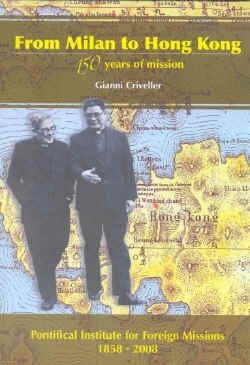
From Milan to Hong Kong
150 years of missio
Pontifical
Institute for Foreign Missions
1858 - 2008
Gianni Criveller
|
From Milan to Hong Kong
|
|
The names of PIME
The name PIME is an acronym for the Pontificai Institute for
Foreign Missions (also known as Pontifical Foreign Missions Institute), in
Italian: Pontificio Istituto Missioni Estere.
The name came into existence on May 26, 1926, when Pope Pius XI merged two
missionary institutes: the Foreign Missions of Milan and the Institute of the
Holy Apostles Peter and Paul (Rome). The latter was also known as the Roman
Seminary for the Foreign Missions, in Italian: Seminario Romano per le Missioni
Estere.
The Foreign Missions of Milan were much larger, therefore ali its structures and
rules were maintained in PIME.
Before 1926, PIME was known in Hong Kong under other names. In the present
narration we prefer the use of Foreign Missions of Milan, or Milan Foreign
Missions, in Italian: Missioni Estere di Milano (MEM).
However, other names, indicating the same Institute, are occasionally retained:
Names of people and places
The Romanization of Chinese names and places is a complex issue.
In this book we have adopted the traditional way of naming places and peoples
according to their local dialects (Cantonese, Hakka or Hoklo). In this way the
Romanization is consistent with the sources and would be more familiar to most
readers. Examples: Sai Kung and not Xigong; Po On and not Bao'an; Hoi Fung and
not Haifeng; Tao Yuen and not Daoyuan; To Yeung and notTuyang; Tea Tsai and not
Tingqian.
Chinese who have western names are presented as follows: western first name in
its English form, followed by the Chinese family name, in the most commonly
established formo For example: Andrew Leong and not Liang Jingzi; Joseph Zen and
not Zen Ze-kiun.
The complete list of Chinese names of people and places is given in the appendix
as follows: name as it appears in the book in alphabetical order; Pinyin
Romanization; Chinese character in the traditional form.
Names of western persons, including the names of PIME missionaries, are always
kept in their original language. For example: Lorenzo Bianchi and not Lawrence
Bianchi. The names of all the 207 PIME missionaries in Hong Kong, including
those who remained for a short period, those who left the Institute and those in
Taiwan, are given in the appendix of the book together with their Chinese names,
listed in order of arrival in Hong Kong.
Illustrations
The illustrations included in the book were chosen far their
artistic and histarical value.
They cannot be reproduced without the written permission of the Hong Kong PIME
Superior.
The chapters in the first part are illustrated with 26 engravings. Twenty-three
of them are chosen from the nearly 300 engravings that the first Italian
missionary magazine, Le Missioni Cattoliche, published between 1872 and the end
of the 19th century, illustrating China and the China mission. Le Missioni
Cattoliche has been published by the Foreign Missions of Milan (since 1872), and
is still published by PIME in Milan under the name of Mondo e Missione. Three
more engravings (one on Paolo Reina and two on St. Calocero's seminary), were
published in 1884 by La Strenna delle Missioni Cattoliche, an offprint of Le
Missioni Cattoliche.
The engravings have been reproduced far the first time since its initial
publication in the 19th century. Eleven of them are signed by Canedi. Francesco
Canedi (1841-1910) was a noted engraver from Milan. The other illustrations are
signed by seven other artists, whose names are not always clear.
The photos that illustrate the other parts of the book belong to PIME Photo
library in Milan, to PIME Hong Kong or PIME members.
The names of PIME missionaries and other religious personnel shown in thirteen
group photographs are listed on page 199.
Thirteen photographs (see page 199) are fram the Archives of the Hong Kong
Catholic Diocese. We would like to thank the Director and the staff far the kind
assistance and the permission to reproduce them.
Acknowledgements
I would like to thank Fr. Dina Vanin far translating most of the
book into English, and far revising it. I also wish to thank Ms Moira Shaw far
proofreading the text and Mrs. June Livingston far her helping hand.
I would like to express my gratitude to ali who helped in the collection of the
photos, especially the staff of the PIME Centre in Milan, particularly Mr. Mauro
Maret and Ms Rosalba Rivelli. Mr. Bruno Maggi, to whom go my sincere thanks,
drew the four maps in the appendix and collabarated in designing the cover page.
A special thank goes to Fr. Mario Marazzi who assisted me in many ways. I also
wish to thank Fr. Sergio Ticozzi as I relied on his monumental history of PIME
in Hong Kong far some of the material in this book.
I am indebted to Ms Jade Leung and the staff of Vox Amica Press far their
assistance in producing the book on time. Graphic designers Mr. Anthony Li and
Christopher Lau have also gone out of their way to meet the tight deadline. To
them go my thanks.
For the dedication of the book, see the postscript on page 200.
 |
|